

Many industrial companies invest heavily in marketing initiatives, SEO, paid advertising, trade shows, email campaigns, and LinkedIn content, yet struggle to answer one critical question:
Which activities are actually generating revenue?
Without a clear understanding of revenue attribution, industrial manufacturers often make marketing decisions based on assumptions instead of data. They increase budgets, switch agencies, redesign websites, or launch new campaigns without knowing what’s truly influencing closed-won business.
The reality is that revenue attribution sits at the center of every successful industrial marketing strategy. If you can’t connect marketing activity to revenue outcomes, it’s nearly impossible to scale what works and eliminate what doesn’t.
This article breaks down the three key areas manufacturers should evaluate to improve marketing performance, strengthen their industrial marketing funnel, and generate more qualified opportunities through better RFQ optimization.
Why Revenue Attribution Matters in Industrial Marketing
Revenue attribution is the process of identifying where your deals originate and understanding which marketing channels contribute to revenue generation.
For industrial companies, lead generation often comes from multiple touchpoints:
- Organic search
- Paid advertising
- LinkedIn and social media
- Trade shows
- Referrals
- Dealer and distributor networks
- Email marketing
- Outbound sales efforts

The challenge is that many organizations track lead sources but fail to accurately track revenue sources. A channel may generate a high volume of leads while contributing very little to actual sales. Conversely, another source may generate fewer opportunities but consistently produce high-value customers.
Lead Attribution vs. Revenue Attribution
A common mistake is focusing exclusively on lead volume.
For example:
Channel | Leads Generated | Closed-Won Deals |
Trade Shows | High | Low |
Paid Media | Medium | High |
Organic Search | High | Medium |
Distributor Network | Low | Very High |
Looking only at lead counts can be misleading. A channel may generate a high volume of inquiries while contributing very little to closed-won business. Revenue attribution helps manufacturers see beyond lead volume by identifying which channels create qualified opportunities, which opportunities turn into sales conversations, which deals ultimately close, and where marketing investments generate the highest return.
When tracked consistently over time, this data provides a clear roadmap for making smarter marketing decisions and driving sustainable growth.
The Hidden Gaps Inside the Industrial Marketing Funnel
Once attribution data is established, the next step is identifying performance bottlenecks throughout the funnel. Many manufacturers have traffic, impressions, and engagement but struggle with conversions.
Examples include:
- Website visitors leaving key pages immediately
- High traffic landing pages with low conversion rates
- Contact forms that receive little engagement
- RFQ pages that fail to generate submissions
- Paid campaigns generating clicks but no opportunities
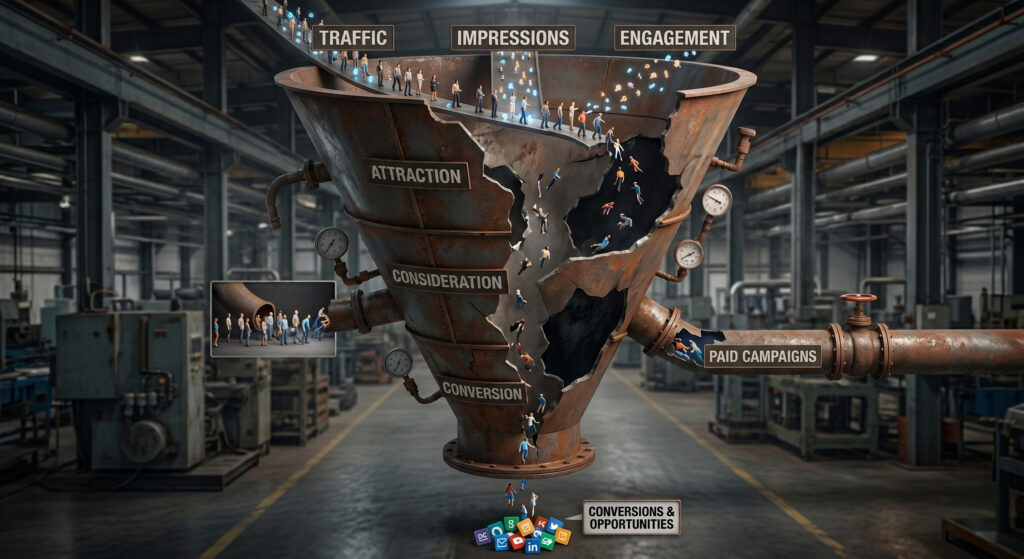
These issues represent performance gaps that prevent prospects from moving through the industrial marketing funnel.
Using Data to Identify Conversion Barriers
Marketing metrics tell a story, and that story often reveals where prospects are getting stuck in the buying process. If a paid advertising campaign generates strong click-through rates but no inquiries, the issue may not be the campaign itself. It may be the landing page experience, messaging, or conversion process.
Similarly, if organic traffic is increasing but rankings remain outside the top search positions, SEO efforts may require refinement before they can generate meaningful results.
Instead of making assumptions, industrial marketers should analyze traffic sources, bounce rates, time on page, conversion rates, RFQ submissions, sales-qualified leads, and closed-won opportunities together. The data often reveals exactly where adjustments are needed and helps identify the barriers preventing visitors from becoming customers.
RFQ Optimization: A Critical Revenue Lever
For many manufacturers, the request-for-quote form represents one of the most important conversion points in the buying journey, yet RFQ pages are frequently overlooked. Companies spend significant resources driving traffic to their websites, but if prospects encounter friction when requesting a quote, those marketing efforts can quickly lose momentum.

An effective RFQ optimization strategy focuses on making it as easy as possible for visitors to take the next step. Complex forms, unnecessary fields, and unclear instructions can discourage qualified prospects from submitting an inquiry. Instead, manufacturers should streamline the process and provide a clear path for prospects to start a conversation.
Just as important is the messaging surrounding the RFQ process. Visitors should immediately understand what your company manufactures, who you serve, what differentiates your business from competitors, and what happens after they submit a request. Reducing uncertainty and setting clear expectations can significantly improve conversion rates.
User experience also plays a critical role. RFQ pages should load quickly, function seamlessly on mobile devices, feature clear calls-to-action, and include trust-building elements that reinforce credibility, a hallmark of a strong manufacturing website design. While these may seem like small details, even modest improvements can have a meaningful impact on conversion rates and ultimately generate more revenue from existing website traffic.
Why Marketing Activity Volume Often Falls Short
One of the biggest misconceptions in industrial marketing is that simply participating in marketing channels should produce results.
The reality is that volume matters.
Many companies claim that strategies like social media, email marketing, SEO, or outbound sales don’t work when the actual issue is insufficient activity.

Examples of Activity Gaps
LinkedIn Marketing
Publishing one post per week is unlikely to generate meaningful brand visibility.
Consistent posting creates:
- Increased awareness
- More engagement opportunities
- Greater visibility among decision-makers
- More branded search activity
Email Marketing
Success depends on:
- Consistent outreach
- Deliverability rates
- Open rates
- Response rates
- Conversation generation
Email should focus on starting conversations rather than simply promoting products.
Outbound Sales Activity
Cold calling remains effective in many industrial sectors when executed at sufficient scale.
Organizations should evaluate:
- Calls made per week
- Conversations generated
- Meetings scheduled
- Opportunities created
Activity levels directly influence pipeline growth.
How a Strong Industrial Marketing Strategy Connects Everything
A successful industrial marketing strategy aligns every stage of the funnel, from generating awareness to converting opportunities into revenue.
Top of Funnel: Activity Generation
At the top of the funnel, the focus is on generating awareness and attracting qualified visitors. This includes activities such as SEO, paid media, content marketing, social media, email campaigns, and outbound prospecting. While many companies believe they are doing enough marketing, the reality is that insufficient activity is often one of the biggest barriers to growth. Consistent visibility is what creates opportunities for prospects to enter the funnel in the first place.

Middle of Funnel: Performance Optimization
Once prospects enter the funnel, the focus shifts to conversion. Website engagement, landing page performance, lead nurturing efforts, and RFQ optimization all play a role in determining whether visitors take the next step. Even strong marketing campaigns can underperform if prospects encounter friction during the buying journey. This is why identifying performance gaps and optimizing conversion points is essential to improving overall marketing results.
Bottom of Funnel: Revenue Attribution
At the bottom of the funnel, revenue attribution provides the insights needed to understand what is actually driving business growth. By analyzing lead quality, opportunity creation, closed-won business, channel effectiveness, and return on marketing investment, manufacturers can identify which activities are generating revenue and which areas require improvement. This visibility allows companies to make informed decisions and invest more confidently in the channels that produce results.
When viewed as a complete system, the industrial marketing funnel becomes much easier to optimize. Activity at the top drives awareness, performance in the middle improves conversions, and attribution at the bottom reveals what is ultimately contributing to revenue. Together, these three areas create a framework for sustainable and measurable growth.
The Bottom Line on Revenue Attribution
Many industrial companies focus on tactics before understanding performance.
However, sustainable growth begins with visibility.
When manufacturers accurately track revenue attribution, identify funnel performance gaps, and increase activity levels strategically, they gain a clearer understanding of what drives revenue and where resources should be allocated.

Rather than guessing which marketing initiatives are working, companies can make decisions backed by data, improve conversion rates throughout the industrial marketing funnel, and create a repeatable system for growth.
The companies that consistently outperform competitors aren’t necessarily spending more, they simply know which activities are producing results and optimize accordingly.
FAQs
What is revenue attribution in industrial marketing?
Revenue attribution is the process of identifying which marketing channels, campaigns, and activities contribute to closed-won revenue. It helps manufacturers understand where sales opportunities originate and which investments generate the highest return.
Why is revenue attribution important for manufacturers?
Without attribution, companies may invest in channels that generate leads but not revenue. Attribution provides visibility into which marketing efforts create qualified opportunities and drive business growth.
How does RFQ optimization improve lead generation?
RFQ optimization reduces friction during the quote request process, improves user experience, and increases conversion rates, helping manufacturers generate more qualified inquiries from existing website traffic.
What are common weaknesses in an industrial marketing funnel?
Common issues include low-converting landing pages, ineffective RFQ forms, poor lead qualification, weak nurturing processes, and insufficient marketing activity at the top of the funnel.